

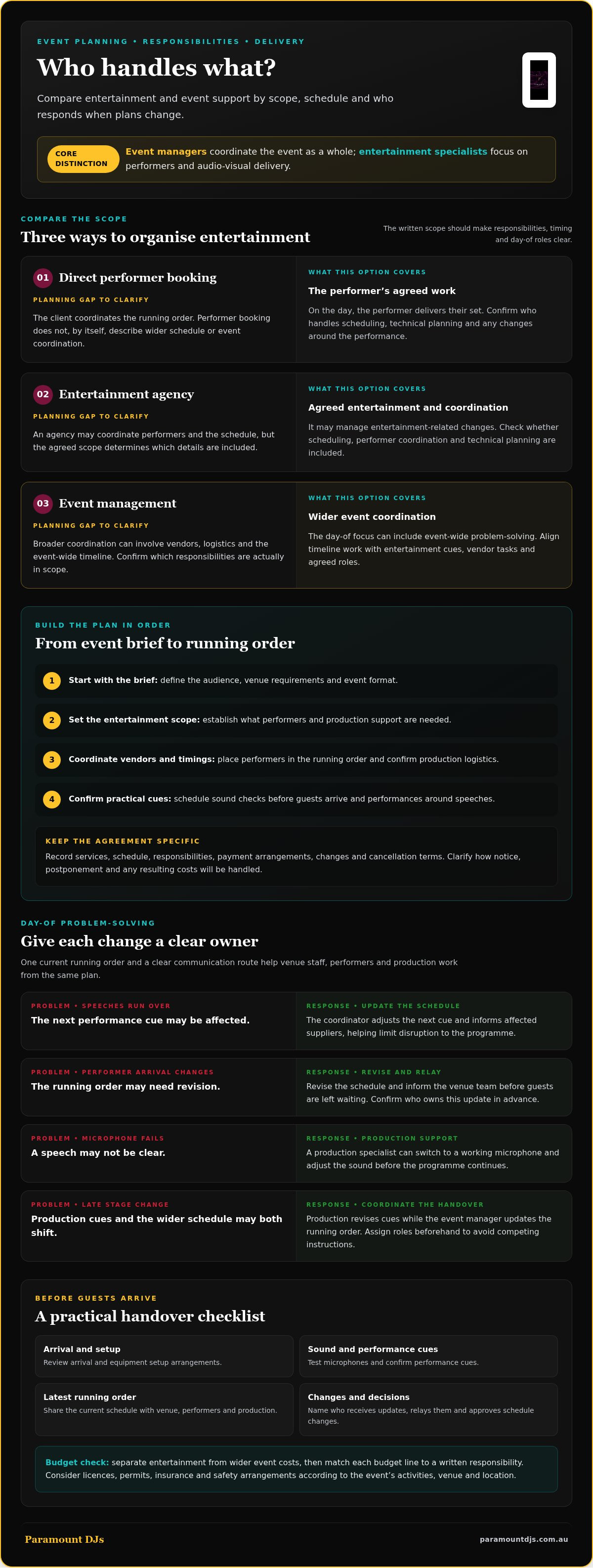
The key difference is scope: event managers coordinate the event as a whole, including its budget and timeline, while entertainment specialists focus on performers and audio-visual delivery. Compare what each service organises before the event, how it fits the schedule and who handles problems on the day. This makes event entertainment management services easier to assess by responsibilities, not just by the entertainment provided.
A larger entertainment setup may seem to require more planning. The practical question is how each service fits your event’s needs, timing and budget priorities.
This guide explains how planning responsibilities, entertainment and production support, and on-the-day problem-solving differ. It also outlines what to weigh when comparing timelines and budget scope, so you can identify the level of coordination that suits your event.
Key Takeaways
- Compare entertainment options by what their quoted scope covers, then align those responsibilities with your event budget and schedule.
- Plan for day-of changes by clarifying who coordinates performers and responds when the running order shifts.
- Choose event support that matches your needs, from entertainment delivery to broader coordination across the event.
- For events in major Australian cities, focus on how the provider’s services fit your venue, audience and event format.
Event budgets and timelines
Start by separating entertainment from the event’s wider costs. Event management may cover venue coordination, vendors, budget, logistics and day-of problem-solving. Entertainment production focuses on performers and audio-visual elements, such as sound, lighting and visuals. A clear scope shows which responsibilities belong in each budget line.
Agencies can coordinate several entertainment details, while direct booking means arranging with performers yourself. Compare the work included, such as scheduling, performer coordination and technical planning.
Licences, permits, insurance and safety arrangements depend on the event’s activities, venue and location in Australia. Include these considerations in planning, alongside access, equipment setup and crowd movement.
Corporate events may feature a DJ or speakers, while weddings may include a DJ or live performance. Festivals can combine performers with sound, lighting and visual production, depending on the programme.
Begin with the event brief, audience and venue requirements. Then set the entertainment scope, coordinate vendors, add performers to the running order and confirm production logistics. For example, schedule sound checks before guests arrive and performances around speeches.
A written agreement should describe the services, schedule, responsibilities, payment arrangements, changes and cancellation terms. Record how notice, postponement and any resulting costs will be handled, so both parties understand the agreed process.
| Option | Budget scope | Timeline coordination | On-the-day focus |
|---|---|---|---|
| Direct performer booking | Performer’s agreed work | Client coordinates running order | Performer delivers their set |
| Entertainment agency | Agreed coordination and entertainment scope | May coordinate performers and schedule | May manage entertainment-related changes |
| Event management | Wider event coordination, potentially including vendors and logistics | Event timeline across activities | Event-wide problem-solving |
Choose the option whose written scope covers your event’s coordination needs, then align its responsibilities with your budget and running order.
For event-wide coordination, include the event manager’s timeline work in the budget and assign responsibilities clearly. Event managers create an event timeline and work to ensure the event runs smoothly. Align that timeline with entertainment cues, vendor tasks and agreed on-the-day roles.
On-the-day problem-solving
A running order gives performers, venue staff and event managers a shared reference. If speeches run over, the coordinator can adjust the next cue and inform affected suppliers. Clear communication helps prevent a delayed performance from disrupting the rest of the programme.
Every potential problem needs a clear owner. An event manager may coordinate changes across the event, while an entertainment specialist focuses on performers and production. For example, if a performer’s arrival time changes, the schedule can be revised and the venue team informed before guests are left waiting.
Audio issues call for a different response. A production specialist can test microphones, manage live sound and adjust audio so speakers remain clear. If a microphone fails during a speech, the team can switch to a working microphone and adjust the sound before the programme continues.
Lighting, sound and performer coordination can affect one another. A late stage change may require the production team to revise cues while the event manager updates the running order. Assigning responsibilities beforehand helps avoid competing instructions during a busy changeover.
- Keep one current schedule: share the running order with the people coordinating the venue, performers and production.
- Set a communication route: decide who receives updates and passes changes to the relevant teams.
- Identify decision-makers: clarify who can approve a schedule change or revised performance cue.
- Plan practical alternatives: note a suitable programme adjustment if a performer or technical element is delayed.
Before guests arrive, review arrival and setup arrangements, test microphones, confirm performance cues and circulate the latest schedule. During the event, have one coordinator communicate updates and record changes that affect later performances.
For a smooth handover between entertainment and the wider programme, plan entertainment around your event’s running order.
Choosing event entertainment management in Australia
Start with the event brief. A corporate conference, wedding and outdoor festival have different entertainment priorities. Record the audience, venue, atmosphere and programme before comparing providers. Those details help define whether you need performer coordination, production support or broader event management.
Next, compare each proposal by scope, not its headline description. Check which tasks are included, such as booking performers, coordinating arrival times, managing sound requirements or updating the running order. For a conference, clarify how entertainment fits around speakers and presentations. For a wedding, consider transitions between formalities and dancing.
Ask how responsibilities are divided. Event management may cover vendors, venue logistics and the wider schedule, while event production focuses on entertainment and audio-visual delivery. A written scope should name the person responsible for each task. This makes gaps easier to spot, such as performer timing being left out of the production schedule.
- Match experience to format: look for relevant examples, such as conference entertainment or live venue programming.
- Compare communication: identify who receives schedule changes and relays them to performers or venue staff.
- Review the agreement: check services, schedule, payment arrangements, changes and cancellation terms.
- Consider problem-solving: ask how a delayed performance or sound issue would affect the programme.
In Australia, permits, safety arrangements and venue requirements can depend on the event’s location and activities. Build these practical considerations into the plan rather than treating entertainment as a separate item. At an outdoor festival, for example, site access and sound setup may shape performer logistics.
Finally, compare the proposed scope with your priorities. If you already have an event manager, focused entertainment coordination may be enough. If vendor logistics and the full schedule also need attention, broader event management may be more suitable. The right event entertainment management services clearly match the work to your event’s format, audience and programme.
Which event entertainment providers operate in major Australian cities?
Across Australia, event entertainment may come from performers booked directly, agencies coordinating talent, or production specialists managing sound, lighting and visuals. These provider types meet different needs. Direct booking may suit an event with a simple programme, while a more complex schedule may call for separate entertainment and production coordination.
Start with the venue and event format. An indoor function space may have different access and setup arrangements from an outdoor site. Share the venue’s requirements, event schedule and entertainment brief when comparing providers. These details help show whether each proposed service suits the location and programme.
A corporate function may need entertainment arranged around presentations and guest arrival. A festival could require coordination between performers and production teams. A wedding may focus on transitions between formalities and the reception. The right provider category depends on these practical requirements, not the event label alone.
- Direct performers deliver their booked performance, while the organiser handles wider timing.
- Entertainment agencies coordinate talent according to the agreed scope.
- Production specialists focus on entertainment-related sound, lighting and visual elements.
- Event managers coordinate broader event elements, including vendors and logistics.
Compare providers using the same brief. Include the venue, performance needs, technical requirements, schedule and division of responsibilities. Then assess whether each proposal covers the work your event needs. A single performance may need little coordination; a multi-part programme may involve several providers and handovers.
For an event-focused discussion, explore entertainment options for your event and consider how they fit your format, venue and running order.
Event entertainment is supplied by performers booked directly, agencies that coordinate talent, and production specialists managing sound, lighting and visuals. Event managers may also coordinate wider event elements, including vendors and logistics.
Paramount DJs: Wedding DJs
Paramount DJs provides Wedding DJs for couples planning entertainment around their wedding schedule and atmosphere. A DJ offers a music-focused option for the reception, while DJ & Sax adds a live performance element. Choose the format that suits your desired tone and the role entertainment plays in your programme.
For other occasions, Paramount DJs also offers Corporate Event DJs and Photo Booth Hire. These options serve different goals, from entertainment at a corporate gathering to an activity that encourages guest participation. Consider your audience, venue and running order to decide which offering fits.
To discuss entertainment for your wedding or event, contact Paramount DJs with your plans.
Shape your event’s next step
Give entertainment a clear role in your event instead of treating it as a last-minute addition. Decide what atmosphere you want guests to experience, then consider how music and interactive moments can help create it. A focused brief makes the conversation more productive and connects your priorities with the event programme.
For a wedding, Paramount DJs offers Wedding DJs, Photo Booth Hire and DJ & Sax. Each can shape the guest experience differently, from a music-led reception to a live performance or interactive activity. Consider which option suits your occasion and the moments you want guests to remember.
Choosing event entertainment management services comes down to matching your event’s purpose with its entertainment plan. A conversation about your event format, venue and preferred atmosphere can help you choose a suitable direction.
Contact Paramount DJs about your event and take the next step towards an entertainment plan that feels right for your celebration.
Frequently Asked Questions
What services do event entertainment management companies provide in Australia?
Services range from coordinating performers to managing entertainment production, depending on the agreed scope. Event management may also cover wider event elements, while production specialists focus on sound, lighting and visuals. For example, a corporate function may need performers coordinated around presentations, while a festival may require entertainment and technical elements to be planned together. Defining responsibilities helps prevent gaps between event and production teams.
How much do event entertainment management services cost in Australia?
The price depends on the event and its requirements, and is provided after a quote request. Cost factors include the entertainment format, performer requirements, schedule, venue logistics and production scope. A DJ performance and a programme involving several performers have different coordination needs. When requesting a quote, share the event type, venue, date and preferred entertainment so the proposed scope reflects the work involved.
How far in advance should I book event entertainment in Australia?
Book once you have a likely event date and venue, especially if entertainment must fit around a detailed programme. Timing depends on the event date, format, performer requirements and level of coordination needed. A wedding reception with set formalities benefits from early schedule planning; a corporate function may need entertainment aligned with its presentation agenda. Share confirmed details first, then update the running order as plans develop.
What are common risks and backup plans for live event entertainment?
Common challenges include performer delays, running-order changes and microphone or sound issues. Agree on a practical response for each beforehand: decide who can adjust the schedule, identify a suitable programme change and ensure the sound team knows whom to contact. If a speech is delayed by a late arrival, moving a flexible segment can help the programme continue smoothly.


